Your diary isn’t full. It’s infected.
Not with work - work is fine - but with other people’s priorities...
... digital noise, and the polite lie that you can “just squeeze it in”. Your To Do List isn’t the problem. Your attention Is being mugged.
If you’ve ever ended a day exhausted, busy, and strangely unsure what you actually achieved… congratulations. You’re not lazy. You’re living in an attention economy with a Victorian productivity toolkit.
I used to think “time management” was the grown-up version of colouring inside the lines. Plan your week. Protect your diary. Batch your emails. Be disciplined. Then real life turns up on a Tuesday at 10:17am, sets fire to your calendar, and asks if you’ve got “just five minutes” for something urgent, important, and completely unplanned.
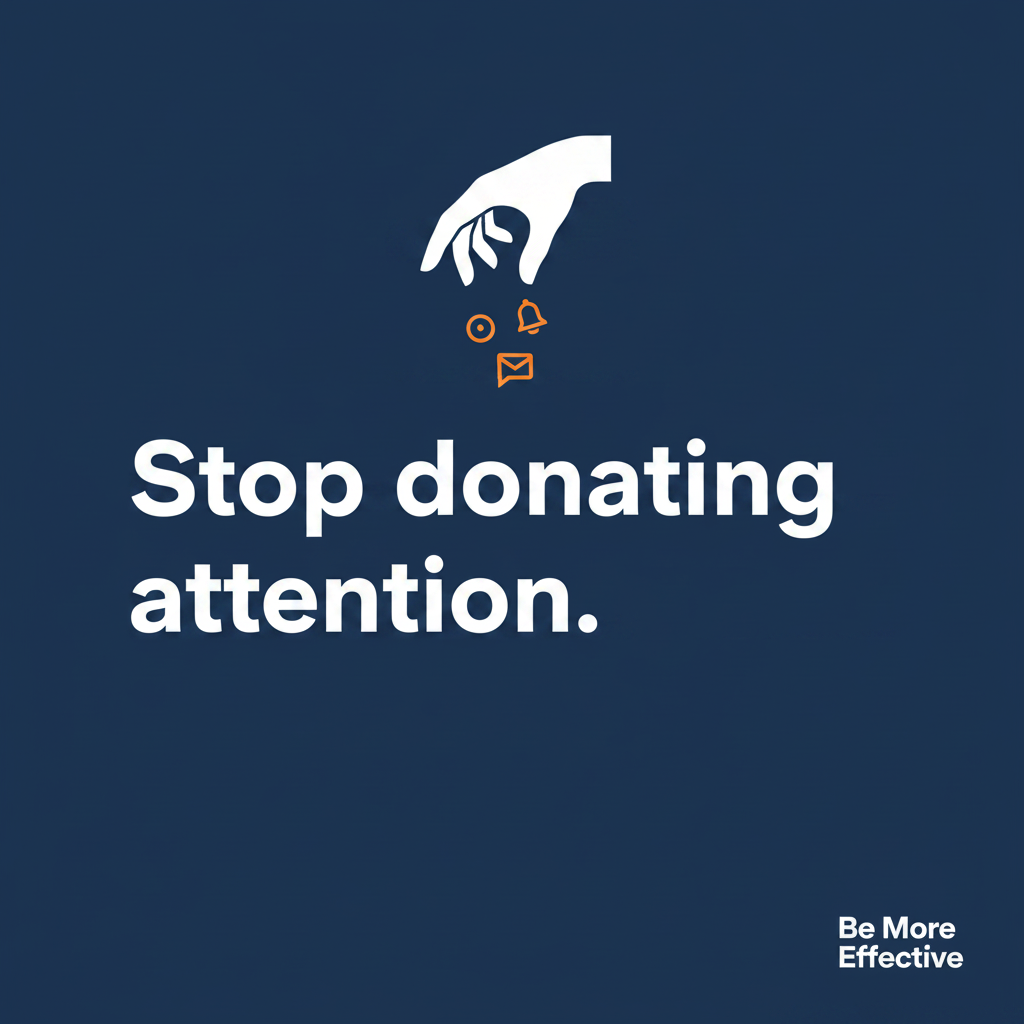
And that’s the moment most productivity advice quietly fails. Not because the gurus are wrong. But because they’re often solving the wrong problem. The modern problem isn’t that you don’t know what to do. It’s that you can’t hold your attention on the right thing long enough to finish it, while your energy gets nicked in small coins all day by notifications, meetings, and the emotional labour of being “available”.
The productivity world has matured. Even the big names have moved beyond “make a better list” and into the messier truth: you’re not managing time. You’re managing decisions, attention, and energy.
Franklin Covey are blunt about it: time management alone isn’t enough, you need decision, attention, and energy management to get to “extraordinary productivity”. Dave Allen (GTD) comes at it from another angle: your mind is for having ideas, not holding them. Cal Newport takes the gloves off and says the ability to focus without distraction is becoming a superpower. Oliver Burkeman basically shrugs and says, “You’ve got about four thousand weeks. Stop pretending you can do everything.”
Different voices. Same diagnosis: the problem isn’t your calendar. It’s the constant theft of your cognitive bandwidth.
The modern productivity trap: “open loops” everywhere
Let’s name the thing that’s quietly draining you: open loops. An open loop is anything unfinished that your brain keeps re-checking like a nervous bouncer:
- “I must reply to that email.”
- “I should book that meeting.”
- “Don’t forget to chase the quote.”
- “I need to think about the restructure.”
You can be sat in a meeting, nodding like a responsible adult, while your mind is running a background tab-count of 37. That’s not a character flaw. That’s biology plus bad systems.
GTD’s genius is simple: capture what has your attention, clarify what it means, organise it somewhere trustworthy, review it, then engage. The point isn’t to become a productivity monk. The point is to stop using your working memory as a storage unit.
Mini case study: I’ve coached MDs who swear they “work well under pressure”. What they mean is: they’ve normalised anxiety as a project management tool. The moment we built a proper capture-and-clarify habit (ten minutes, twice a day), their stress dropped, not because the workload changed, but because the mental clutter stopped ambushing them mid-task.
Deep work isn’t a luxury. It’s the only place value is created.
Here’s the uncomfortable truth: most of your day is spent on activity that feels like work but produces very little value.
Cal Newport’s “deep work” idea lands because it’s painfully obvious once you see it: the work that changes results - strategy, problem-solving, writing, designing, leading requires uninterrupted concentration. Yet we’ve built workplaces that treat uninterrupted concentration like an act of rebellion.
So, people do “deep work” the way teenagers do revision: late at night, fuelled by panic, and slightly resentful.
One client (construction, owner-led, classic “always on” type person if you know what I mean…) was doing 60-hour weeks and still felt behind. We didn’t add hours with our advice. He agreed to ringfenced two 90-minute-deep work blocks, three times a week, for the three outcomes that mattered most: pipeline, people, process. Within a month, he felt calmer, not because life got easier, but because the important work finally had a protected home.
Deep work isn’t about being intense. It’s about being intentional.
Feel-good productivity: energy is the multiplier, not the reward
Ali Abdaal’s “feel-good productivity” is a useful antidote to the grind culture nonsense. Not because work should be a constant party (it won’t be), but because joy and energy aren’t fluffy extras, they’re performance inputs.
If your week is structured so your best energy is spent on low-value tasks, you’ll end up doing your high-value work with your worst brain. That’s like sending your best salesperson to tidy the stationery cupboard while the trainee handles the biggest account.
As a practical example, if your “magic window” is 8:00–10:30, that’s not the time for email triage and internal updates. That’s the time for the work that pays the bills: proposals, client strategy, difficult conversations, designing the programme, writing the keynote.
Your calendar should reflect your focus and energy, not just your availability.
The “fewer things” principle: disciplined focus with adult consequences
This is where Burkeman, Jim Collins, Bain-style execution thinking, and Lencioni’s clarity message all shake hands.
- Burkeman: you can’t do everything, so stop building a life around catching up.
- Collins: disciplined focus - do the vital few consistently.
- Bain (at their best): execution comes down to ruthless prioritisation and clarity.
- Lencioni: lack of clarity creates politics and confusion - people fill the vacuum with noise.
In plain English: when you don’t choose your priorities, your inbox will. So here’s the Bob Hayward version of that question: What are you saying “yes” to that is quietly killing your best work?
And here’s the practical move. Pick three outcomes for the next 90 days that, if delivered, make everything else easier. Then treat those outcomes like a protected species.
When new work arrives, run it through a filter that forces honesty:
- Does this directly support one of the three outcomes?
- If yes: schedule it.
- If no: park it, delegate it, diminish it, or delete it.
That’s not a productivity hack. It’s leadership.
Actionable takeaways
- Create a “capture habit” twice a day (10 minutes). One place. No exceptions. If it’s in your head, it’s stealing attention.
- Ringfence two or three deep work blocks per week (start with 60–90 minutes). Put them in the diary like client meetings. Because they are. Start with two. Build up to three.
- Choose three 90-day outcomes and make them the filter for new work. If it doesn’t serve them, it doesn’t get prime time.
- Move low-value admin to low-energy slots. Email, approvals, scheduling, internal updates - batch them when your brain is naturally flatter.
- Reduce “availability theatre”. Being instantly responsive feels professional, but it’s often just distraction dressed as service.
In summary
Most people don’t need a better to-do list. They need a better default. A default that protects attention, respects energy, and forces real prioritisation, because the world will happily fill your day with urgent nonsense if you let it.
The gurus aren’t wrong. They’re just incomplete when taken in isolation. Blend the best of them and you get something sturdier: capture the noise (GTD), choose fewer priorities (Burkeman/Collins), protect focus (Newport), manage energy like an asset (Abdaal/modern attention thinkers), and build clarity so the organisation doesn’t generate chaos (Lencioni).
Here is one thing you can do next.
Today, pick your three 90-day outcomes, then book two 90-minute-deep work sessions this week that directly move those outcomes forward. Not “when you get a chance”. Put them in the diary now, before someone else books your best brain for a meeting you won’t remember by Friday.
For more information please send a message via the Contact Us Page. Or you can register for an upcoming webinar.