Why Your “Gut Feel” Is Costing You Top Talent
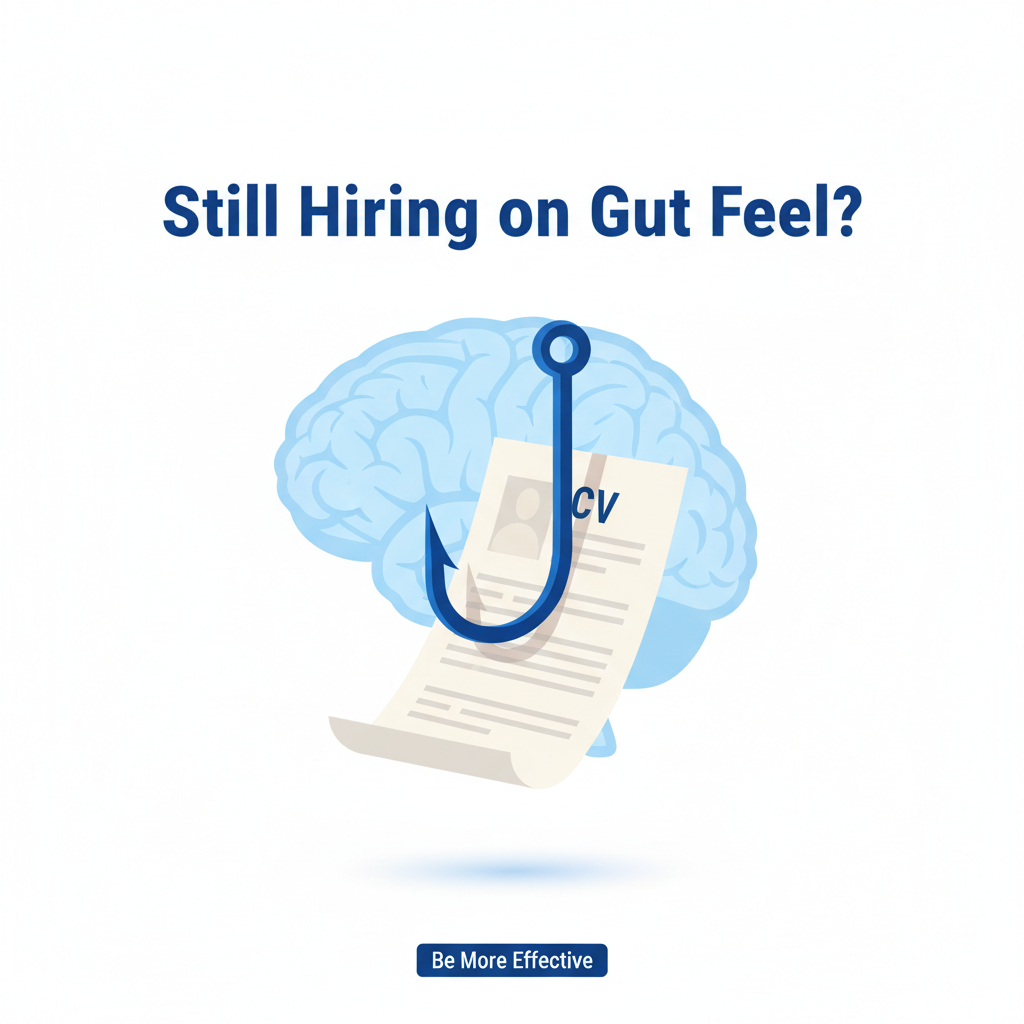
In boardrooms and HR meetings across the UK, the same story keeps repeating.
“We’ve got good people in HR.”
“Our managers are great judges of character.”
“We’ve always done it this way.”
And yet:
- Turnover is higher than it should be
- Teams feel unbalanced
- “Promising” hires quietly underperform
- Recruitment feels reactive, slow, and expensive
The uncomfortable truth?
If your recruitment is still driven mainly by CVs, interviews, and gut feel, you are competing with organisations who are quietly using data, AI, and predictive analytics to out-hire you.
They’re not just filling roles faster. They’re building stronger, more stable teams – and doing it with less waste, less bias, and more confidence.
This isn’t about replacing humans with machines.
It’s about replacing guesswork with evidence.
The Hidden Cost of “Traditional” Recruitment
Let’s be blunt: traditional recruitment is built on three fragile pillars:
- Subjective judgment – “I liked them, they seemed confident.”
- CV theatre – polished documents that often say more about writing skills than real performance.
- Unstructured interviews – different questions, different standards, different days, different moods.
Global research backs up what many HR leaders already suspect:
- Unstructured interviews on their own are poor predictors of job performance.
- Hiring managers consistently overestimate their ability to “read people”.
- Organisations dramatically underestimate the cost of a bad hire – often 1–3x salary once you factor in disruption, lost opportunities, and team impact.
And yet, many companies still:
- Don’t track the performance of hires over time
- Don’t link recruitment decisions to retention and productivity data
- Don’t measure which hiring channels or profiles actually work best
That’s like running a multi-million-pound business with no management accounts – just a “feeling” that things are going fine.
What Data-Driven Recruitment Actually Means (Beyond Buzzwords)
“Data-driven recruitment” gets thrown around a lot, usually with a picture of a robot and some graphs. Let’s strip it back.
At its core, data-driven recruitment means:
- Using evidence, not opinion, to decide who to hire
- Linking hiring decisions to real outcomes – performance, retention, culture fit, team impact
- Using AI and predictive analytics to spot patterns humans can’t see at scale
- Standardising your process so you reduce bias and increase fairness
Practically, that looks like:
- Objective assessments (behavioural, cognitive, motivational)
- Structured, scorecard-based interviews
- Predictive models built from your own historic hiring data
- Tools that flag which candidates are most likely to succeed in your environment
- Matching candidates not just to a role, but to a team and a Line Manager
It’s not about “hiring by algorithm”. It’s about giving your people leaders better information so they can make better decisions.
Problem #1: Bias You Can’t See – But Your Data Can
Every organisation says it wants diversity, fairness, and inclusion.
Very few can honestly say their hiring process supports that.
Human bias isn’t always malicious. It’s often unconscious and subtle:
- Preferring candidates who “feel like us”
- Overvaluing confidence and under-valuing quiet competence
- Letting first impressions colour the entire interview
- Mistaking “good in interview” for “good in role”
Without data, those biases go unchallenged.
With data, you can:
- Compare interview scores with later performance
- See which managers consistently over- or under-score candidates
- Identify which attributes actually predict success in your environment
- Standardise decision-making across teams and locations
AI and predictive tools, when designed and audited properly, can help reduce bias by forcing decisions to be based on job-relevant criteria – not hunches.
If your current process can’t show you where bias creeps in, it’s not just a moral risk – it’s a commercial one. You are almost certainly missing out on top performers who don’t “look the part” in a traditional process.
Problem #2: Turnover That Looks “Inevitable” – But Isn’t
Most organisations treat turnover like the weather.
They complain about it, but they don’t believe they can change it.
Yet when you look at the data, patterns emerge:
- Certain roles churn more than others
- Certain managers retain people better than others
- Certain hiring channels produce more “regretted losses”
- Certain personality or motivational profiles burn out faster in specific environments
Data-driven recruitment connects these dots.
Instead of: “We lose a lot of people in year one; that’s just the market.”
You can say: “People hired without X competency and Y motivational profile are 3x more likely to leave within 12 months. Let’s stop hiring them into this role.”
That’s the difference between:
- Continually refilling the same seats and
- Quietly building a stable, high-performing core team
If you’re not using data to understand why people stay or leave, you’re leaving money – and capability – on the table.
Problem #3: Slow, Manual, and Exhausting Processes
Ask your HR team privately how much of their time is spent on:
- Sifting CVs
- Chasing feedback
- Manually scheduling interviews
- Re-explaining the same role to different stakeholders
- Trying to compare notes from wildly different interviews
Now ask yourself: is this really the best use of your most people-savvy professionals?
AI and automation aren’t about dehumanising recruitment. They’re about:
- Automating the admin so humans can focus on judgment and relationships
- Pre-screening at scale so your team only spends time on realistic contenders
- Standardising scorecards so you can compare candidates fairly
- Flagging red and green flags based on your historical data
The result?
- Faster time-to-hire
- Less candidate drop-out
- Less recruiter burnout
- More time spent on high-value conversations with the right people
In a tight talent market, speed and quality matter. Data-driven recruitment gives you both.
The Upside: What Leading Organisations Are Doing Differently
Across sectors, the most forward-thinking organisations are quietly shifting from “recruitment as an event” to recruitment as a data-informed system.
They:
- Build competency and behaviour profiles based on their best performers
- Use scientific assessments (e.g. Birkman, Cognitive Tests, Motivational Maps) to understand how candidates are likely to behave under pressure
- Combine Team and Line Manager profiles with candidate data to predict compatibility
- Track post-hire performance, engagement, and retention – then feed that back into their hiring models
- Treat every hire as a data point, not just a transaction
And crucially, they don’t just buy tools and hope for the best. They redesign their process.
That’s where most companies fall down. They buy an ATS or an AI tool, and yet:
- Don’t define what “success” in the role actually looks like
- Don’t train hiring managers to use structured interviews and scorecards
- Don’t link recruitment data to performance, engagement, and retention data
Technology without process just gives you faster chaos.
Where Most Mid-Market Firms Are Stuck
If you’re a UK mid-market business (25–500 staff, £5–25M revenue), you’re in a particular bind:
- You’re big enough that bad hires really hurt
- You’re small enough that you can’t afford a huge internal analytics team
- You’re busy enough that recruitment is often reactive and rushed
- You’re successful enough that “what we’ve always done” feels safe – until it isn’t
You don’t need a Silicon Valley-sized data science department. You need a practical, evidence-based recruitment system that fits your size, culture, and growth plans.
That means:
- Clarity – What does success look like in each key role?
- Science – Which traits, motivations, and behaviours predict that success?
- Structure – How do we assess those consistently and fairly?
- Feedback loops – How do we learn from every hire, good or bad?
What Needs to Change Inside Most HR & Recruitment Approaches
If this is landing uncomfortably close to home, here are the internal shifts to consider.
1. Move from “CV + Chat” to Evidence + Scorecards
- Define 5–8 core competencies and behaviours for each role
- Build structured interview guides and scorecards around them
- Use consistent rating scales across all interviewers
- Combine this with objective assessments (behavioural, cognitive, motivational)
This doesn’t slow you down – it speeds up decision-making because you’re no longer arguing about vague impressions.
2. Start Measuring the Right Things
Most organisations track:
- Time-to-hire
- Cost-per-hire
Far fewer track:
- Performance at 6, 12, 24 months
- Cultural fit and engagement
- Retention by role, manager, and hiring channel
- Correlation between assessment results and later success
If you don’t measure it, you can’t improve it. If you don’t connect recruitment to outcomes, you can’t call it “strategic”.
3. Treat Manager–Hire Fit as Non-Negotiable
A great candidate with the wrong Line Manager is often a short-term hire.
Using data to understand:
- The Manager’s style, stress behaviours, and expectations
- The candidate’s needs, preferences, and likely pressure responses
…allows you to predict whether they’re likely to click – or clash.
That’s not “soft stuff”. It’s a hard commercial lever for retention and performance.
4. Free HR From Low-Value Admin
If your HR and Talent team are drowning in manual tasks, they will never have the bandwidth to:
- Analyse data
- Refine processes
- Coach hiring managers
- Partner strategically with the business
AI and automation should be taking care of:
- Initial CV screening
- Basic candidate communication
- Scheduling
- Document chasing
So your people can do what only humans can: build trust, probe deeply, and make nuanced decisions.
How We Help Organisations Make This Shift
At Be More Effective, we’ve spent decades combining:
- Scientific selection tools (Birkman, Empathy Styles, Motivational Maps, cognitive assessments)
- Structured, evidence-based interviewing
- Predictive insights on candidate, team, and Line Manager compatibility
…to help organisations build stronger, more stable teams – not just fill vacancies.
We don’t just drop in a tool and leave. We work with you to:
- Clarify what “top 10% performance” actually looks like in your context
- Build or refine your scorecards, interview frameworks, and decision criteria
- Integrate objective assessments into your process without losing the human touch
- Track post-hire performance and retention so your recruitment gets smarter every quarter
The result?
- More objective, defensible hiring decisions
- Lower turnover and fewer “quiet underperformers”
- Faster, more efficient recruitment cycles
- Teams that actually work – on paper and in practice
A Simple Question to Start With
Look at your last 10 hires.
- How many are in the top 10% of their field – or on track to be?
- How many are quietly draining time, energy, and morale?
- Could you prove, with data, why each decision was made – and what you learned from it?
If the honest answer makes you uncomfortable, you’re not alone. Most organisations are in exactly this position.
The difference is what you do next.
If You’re Ready to Move Beyond Guesswork
If you’d like to:
- Reduce the risk and cost of bad hires
- Build a more diverse, high-performing, and stable workforce
- Give your HR and hiring managers better tools, not more pressure
- Turn recruitment from a reactive headache into a strategic advantage
…then it’s time to have a different kind of conversation.
We help UK mid-market businesses use data-driven, scientific recruitment to make better hiring decisions – decisions that stand up over time, not just in the interview room.
If you’re curious about how this could work in your organisation – with your roles, your teams, and your constraints – let’s talk.
You bring your current challenges, recent hires, and honest questions. We’ll bring the data, the methodology, and a practical roadmap.
Contact Be More Effective to explore how data-driven recruitment, AI, and predictive analytics can transform the way you hire – and the results you get from every single appointment.
#DataDrivenRecruitment #AIInRecruitment #ScientificSelection #ReduceBadHires #TeamFit #ManagerFit #RecruitmentProcessOptimisation #EvidenceBasedHR #TalentTransformation
For more information please send a message via the Contact Us Page. Or you can register for an upcoming webinar.