Stop Managing Time. Start Managing Attention.
If time management worked the way the internet promised, we’d all be sipping herbal tea at 4pm with an empty inbox and a smug sense of completion. Instead, most people finish the day with 47 tabs open, a calendar that looks like Tetris, and the vague feeling they’ve been busy… but not effective.
That’s because the real constraint isn’t time. It’s attention.
Why Time Management Failed (And Why We Keep Pretending It Works)
Cal Newport calls it Deep Work: the ability to focus without distraction on cognitively demanding tasks. Maura Thomas goes further and argues attention management is the modern successor to time management. And if you’ve ever tried to write a strategy document while Slack pings like a fruit machine, you already know they’re right.
But here’s what most leaders miss: you can’t time-manage your way out of an attention crisis. A perfectly colour-coded calendar doesn’t help if you’re context-switching every six minutes. A productivity app won’t save you if your brain is being interrupted by notifications, meetings, and other people’s urgency.
The real problems we face aren’t about scheduling better. They’re about protecting thinking space in a world designed to steal it.
Problem 1: Urgency Masquerades as Importance
Your inbox is a tyranny of the urgent. Someone needs a decision by 3pm. A client fires off an email marked “ASAP”. A meeting gets scheduled for “quick alignment”. None of these are actually important - they just feel urgent because someone else decided they were.
The cost? Your best thinking never happens. Strategic decisions get made in 15-minute slots between back-to-backs. Culture-shaping conversations happen in hallways. The work that actually moves the needle - the thinking, designing, problem-solving - gets squeezed into whatever’s left.
Problem 2: Shallow Work Expands to Fill the Space
Parkinson’s Law says work expands to fill the time available. But it’s worse than that: shallow work actively crowds out deep work. Emails, Slack, status updates, and “quick questions” are frictionless. They feel productive. They generate immediate feedback (someone replies, a task gets ticked off). Your brain loves them.
Meanwhile, the hard thinking - the analysis that takes two hours to really land, the strategic conversation that needs 90 uninterrupted minutes - gets postponed. Again. Because it’s harder, slower, and doesn’t give you that dopamine hit of “done”.
Problem 3: Decision Fatigue Kills Quality
Every interruption forces a decision: do I respond now or later? Do I switch tasks or finish this thought? These micro-decisions are exhausting. By mid-afternoon, your decision-making capacity is spent. So when the important decision lands - the hire, the strategy pivot, the tough conversation - you’re running on fumes.
The result? Worse decisions. Slower decisions. Decisions made by whoever shouts loudest rather than whoever thinks clearest.
The Shift: Attention Before Time
You don’t need a better to-do list. You need a better attention environment.
This means three things:
First: Define What “Deep” Means in Your Role
Not all work requires deep attention. But some work absolutely does. For most leaders, it’s:
- Strategic thinking and planning
- Coaching conversations that actually develop people
- Decisions that shape culture or direction
- Writing that clarifies thinking (strategy docs, frameworks, clear communication)
- Problem-solving on complex, non-routine challenges
Get specific. What’s the thinking work that only you can do? What requires your best brain, not just your available time?
Second: Protect It Like Revenue
Because it is revenue. The strategic decision that prevents a costly mistake. The coaching conversation that unlocks a leader’s potential. The clear thinking that saves a team from going down the wrong path.
This means:
- Block deep work time on your calendar first. Before meetings, before “open time”, before anything else. Treat it as non-negotiable.
- Switch off non-human notifications. Email, Slack, Teams - all off during deep work blocks. Yes, you’ll survive. The world will keep spinning. Your dopamine will sulk for a bit and then calm down.
- Put your phone in another room. Not on silent. Not face-down. In another room. The moment it’s in your visual field, your attention is half-gone.
- Close unnecessary tabs and apps. Every open browser tab is a cognitive load. Every app notification is a potential hijack.
Third: Build a Distraction Moat
This is about creating friction between you and shallow work. Make it easy to do deep work, hard to do shallow work during protected time.
Some practical moves:
- Use “focus modes” in your calendar (block out focus time, mark as busy, add a note: “Deep work - async responses only”).
- Set up an auto-responder: “I’m in deep work until 2pm. I’ll respond to your message then.”
- Create a “shallow work window” - say, 2–3pm - when you batch-process email, Slack, and ad-hoc requests.
- If you’re in open office, use a physical signal: headphones on = do not disturb.
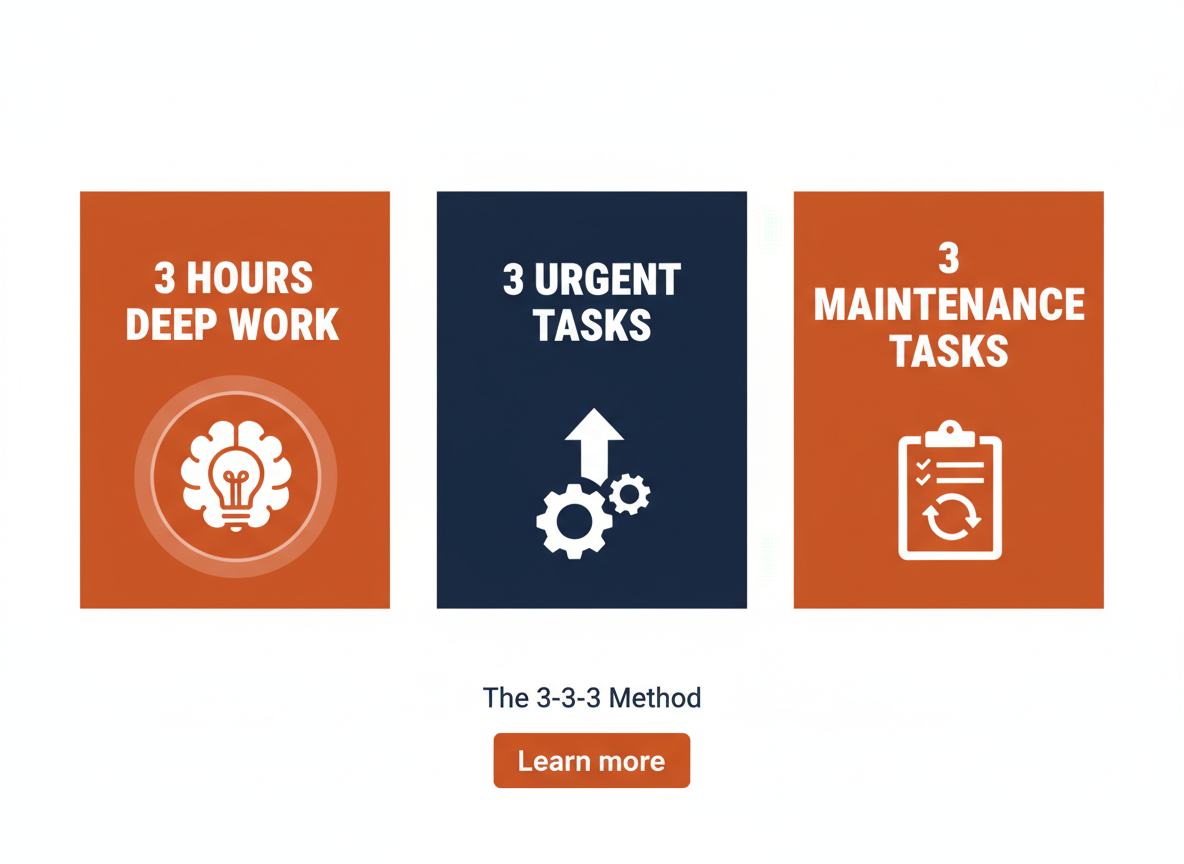
A Simple Daily Structure: The 3-3-3 Method
If you want a framework to start with, try this:
- Three hours of deep work (in one or two blocks, depending on your role)
- Three urgent/important tasks (decisions, key conversations, critical emails)
- Three maintenance tasks (admin, expenses, scheduling, routine comms)
It’s not magic. It’s just a sensible way to stop your day being hijacked by other people’s priorities. And it ensures your best thinking happens when your brain is fresh.
The Real Win
The point isn’t to become a productivity monk or to squeeze more into your day. It’s to make your best thinking possible again.
Because the leaders who win aren’t the busiest. They’re the ones who think clearest, decide fastest, and build cultures where people feel heard and developed.
That only happens when attention is protected.
So tomorrow, ask yourself: what’s one piece of deep work I’m not protecting? And what’s one distraction I can eliminate?
Start there.
For more information please send a message via the Contact Us Page. Or you can register for an upcoming webinar.